
'The reason being we cannot let premiums go beyond a certain point.'

In 2012, private equity investments touched $7.5 billion.

Finance Minister Nirmala Sitharaman will kick start the customary pre-Budget consultation exercise with stakeholders from Wednesday by holding the first such meeting with experts of agriculture and agro-processing industry. She will be seeking inputs from various stakeholders, including industry bodies, farmer organisations and economists for reviving consumption and boosting growth hit by the COVID-19 pandemic. The growth this year is expected to be in the double-digit during the current fiscal.

Chief Economic Adviser (CEA) K V Subramanian on Tuesday exuded confidence that India would achieve double-digit growth in the current financial year on the back of policy initiatives and continuing reforms. He also said the country is well poised to meet the fiscal deficit target of 6.8 per cent of GDP. "At this stage, I can say confidently that we should be able to achieve that fiscal deficit number. "Any shortfalls that might happen on the disinvestment side will also be accompanied by positive surprises that have happened on tax revenue," he told reporters.
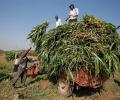
India achieved record foodgrains production this year but the withdrawal of three agri-reform laws and spike in cooking oil prices cast a shadow on the country's resilient agriculture sector that is on course for better harvest in 2022 despite pandemic blues. While soaring production of foodgrains that also helped the government provide free additional rations for COVID-hit poor families for many months together came as a relief, the passing year will be remembered for the long drawn farmers' protest at Delhi borders against the three laws and subsequent repeal of the legislations. The Indian agriculture sector, which was among the few segments that remained robust amid the pandemic gales, is expected to register a growth rate of 3.5 per cent in the current financial year ending March 2022.

For all its claims to economic glory, the majority of India's population lives vulnerable lives, a situation that has only worsened over the past 15 years, to the extent that the government now fears to release economic data or even conduct a proper Census, notes Rathin Roy.

The government has the upper hand in the ongoing negotiations, and it is unclear if a real debate will happen, observes Tulika Narayan.

The Union government could target a fiscal deficit of 5.8-6 per cent of nominal GDP for 2023-24, and it should continue its capital expenditure push and look to simplify the personal income tax regime, economists recommended Finance Minister Nirmala Sitharaman and her team during their pre-Budget interaction on Monday. Starting last week, Sitharaman had eight pre-Budget consultations this time. More than 110 invitees representing seven stakeholder groups participated in these meetings, the finance ministry said in a statement. The stakeholder groups included representatives and experts from agriculture and agro-processing industry; industry, infrastructure & climate change; financial sector and capital markets; services and trade; social sector; trade unions and labour organisations; and economists.

India's climate change goals are turning combustible. On the one hand, a protracted dispute between the government and manufacturers over subsidies threatens to slow the pace of electric vehicle (EV) sales. On the other hand, repeated assertions by different arms of the government over banning sales of new fossil fuel-fired vehicles have queered the pitch for energy investments. Before we address the issue of the recommended diesel vehicle ban in the recent report on energy transition, issued months before the next round of global climate talks begin in Dubai in November, let's look at what's at stake.

The 'sudden volatility' in Adani stocks is entirely due to a series of events that was extreme and unique, and played out in too short a period. Investors and regulators pretended that it wasn't so. But then, along came Hindenburg, which forced some eyes to open, points out Debashis Basu.

He said the Fourth Industrial Revolution will have more importance than the capital.

India scripted history as the ambitious third Moon mission of the Indian Space Research Organisation (ISRO) touched down on the Moon's south pole, propelling the country to an exclusive club of four and making it the first nation to land on the uncharted surface.

India's current account deficit is expected to deteriorate in the current fiscal on account of costlier imports and tepid merchandise exports, according to the Finance Ministry's monthly economic review. The review released on Thursday by the ministry also said that global headwinds would continue to pose a downside risk to growth as crude oil and edibles, which have driven inflation in India, remain major imported components in the consumption basket. For the present, it said, "their global prices have softened, as fears of recession have dampened prices somewhat. This would weaken inflationary pressures in India and rein in inflation."

The Biden administration has proposed a massive hike in immigration fees, including the much sought-after H-1B visas for high-skilled foreign workers, which is very popular among Indian tech professionals. Under the proposed rule, published by the US Citizenship and Immigration Services (USCIS) on Wednesday, the application for the H-1B visa increases from $460 to $780, and L-1 from $460 to $1,385. The application fee for O-1 visas has been proposed to increase from $460 to $1,055.

The defence minister also took an indirect dig at Gandhi for "doubting" the government's intention in the handling of the border row with China and said politics can not be done on the basis of "falsehood".

Rating agencies Crisil and Icra on Monday revised down their India growth projections for the current fiscal and the second quarter mainly due to the ripple effect of slowdown in global growth and mixed crop output. Crisil downgraded the India growth forecast by 30 bps to 7 per cent while Icra pegged the economic expansion at 6.5 per cent for the second quarter of FY2022-23. "We have revised down our forecast for real gross domestic product growth to 7 per cent for fiscal 2023 from 7.3 per cent, primarily because of the slowdown in global growth that has started to impact our exports and industrial activity.

Prime Minister Narendra Modi on Friday said the government is committed towards procurement of agri crops at minimum support price (MSP) and termed it as an important part of the country's food security. He further said that efforts are being made to improve mandi infrastructure so that MSP buying continues in a scientific way.

How should one billion Indians, for whom deprivation has become an inescapable way of life, join us in celebrating 75 years of Independence? And where do we go from here? asks Kalyan Singhal.

Stating that open markets mean more opportunities, Modi said during the last six years the government has made many efforts to make the Indian economy more open and reform oriented.

Modi also hailed the world's largest vaccination programme being carried out in India against COVID-19

Having invested close to $15 billion in Indonesia, Indian firms have lined up further $15-16 billion investments.

A large chunk of the Rs 8.8 lakh crore of investments the Patnaik government had attracted is in uncertain territory.

The World Bank must become Archimedes's lever to help change the world into a more prosperous, inclusive, and sustainable planet in the 21st century. The change in leadership now provides that opportunity, observes Ajay Chhibber.

'We have to make doing business in India easier.'
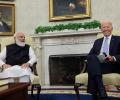
A top Republican lawmaker has welcomed India signing a trade deal with Australia, and urged the Biden administration to enter into a similar arrangement with New Delhi that can advance Washington's strong economic agenda in the strategically vital Indo-Pacific region. "I'm pleased to see #Australia & #India sign a strong trade deal," Senate Foreign Relations Committee Ranking Member Jim Risch said in a tweet. "The US needs to do the same and advance a strong economic agenda in the #IndoPacific. "The Biden Admin's failure to lead hurts US growth and our partnership in the region," Risch said in another tweet.

Three key agriculture Bills, approved by the Lok Sabha, are facing staunch opposition from within the ruling coalition with senior minister Harsmirat Kaur Badal resigning in protest and farmers hitting the street.

The country's gross domestic product (GDP) growth is likely to be 8.8 to 9 per cent in the current financial year, driven by agriculture and industry sectors, Care Ratings said in a report. The country's economy had contracted by 7.3 per cent in fiscal 2020-21. The agency said the outlook for the Indian economy on almost all counts in FY22 would look seemingly better than FY21 on account of the negative base effect.
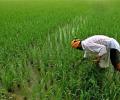
Prime Minister Narendra Modi on Saturday released Rs 20,946 crore to 10.09 crore farmers across India as the 10th installment of financial aid under the PM-KISAN scheme and said there was a need for innovation in agriculture along with promotion of natural farming. Under the Pradhan Mantri Kisan Samman Nidhi (PM-KISAN) scheme, a financial benefit of Rs 6,000 per year is provided to the eligible farmer families, payable in three equal installments of Rs 2,000. The PM-KISAN scheme was announced in the February 2019 Budget.

The growth in the contact-intensive portion of the economy trailed our expectation, highlighting how imperative it is for confidence to improve, either through accelerated vaccinations or otherwise, to drive a sustainable recovery in these sectors, asserts Aditi Nayar.

The high-level panel also asked the government to work towards re-orienting subsidies in a targeted manner from the crop sector to the non-crop sector and redesign the electronic National Agriculture Market.

'The term 'pro-growth' must be qualified somewhat because, while a rising tide will lift all boats, it will not necessarily do so equally.'

'The revival of household savings and investment is the litmus test of whether we are on the road to recovery,' says Nitin Desai.

The President said Indian economy grew at 5.7 per cent during the first quarter of 2014-15.

Till such time that a new governance framework comes into being, the progress of reforms in health, education, land, labour, electricity and agriculture could remain fraught with problems, agitations and delays, observes A K Bhattacharya.

'There will always be a challenge to maintain a fine balance to ensure that the growth keeps happening and inflation is contained.'
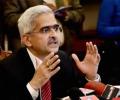
Stating that recent agriculture reforms have opened new opportunities, the RBI Governor said the farm sector is emerging as a bright spot.

The immediate need is to put more money in the hands of agriculture-based and rural households to improve their purchasing power, says S Mahendra Dev.

The government's annual Economic Survey on Friday strongly defended new farm laws, saying they herald a new era of market freedom which can go a long way in improving lives of small and marginal farmers in India. These legislations were designed "primarily" for the benefit of "small and marginal farmers", which constitute around 85 per cent of the total number of farmers and are the biggest sufferer of the "regressive" APMC-regulated market regime, the survey said. The pre-budget document defended the farm laws in the backdrop of long-running farmers' agitation at various borders of the national capital seeking repeal of these legislations expressing concern that they are pro-corporate and could weaken government regulated mandis, also called Agriculture Produce Marketing Committees (APMCs).

Punjab Chief Minister Charanjit Singh Channi on Tuesday allocated portfolios to the new ministers, keeping 14 departments with himself and giving home affairs to deputy chief minister Sukhjinder Singh Randhawa and health to other deputy O P Soni.
.jpg)
Because of corrections in property prices and oversupply in the office segment, the rich are investing in hospitals, warehouses, ATMs and other alternatives to traditional investment options.
 © 2026 Rediff.com - Advertise with us - Disclaimer - Privacy Policy - Sitemap - Feedback - About us - Terms of use - Grievances